Is marine collagen really the secret to radiant, youthful skin?
Marine collagen is hailed as one of the best anti-ageing secrets. Discover how it works, where it comes from, and why it is so popular.

In case you hadn’t noticed, the trend around collagen has exceeded all predictions. Collagen is everywhere in skincare products and beauty supplements, and is celebrated as one of the best anti-ageing secrets. Just ask celebrities such as Jennifer Aniston and Kourtney Kardashian. But what is it exactly? How does it work?
Let us take you through it…
What is marine collagen?
First, let’s look at what collagen actually is. It is quite simply the main structural protein in your body — the one that provides cohesion, resilience, and strength. According to Dr Claude Dalle, anti-ageing physician and president of the French Anti-Ageing Society:
Collagen has a unique function in providing our skin, hair, nails, joints, and bones with their structure, elasticity, firmness, and hydration.
However, our collagen production naturally depletes at a rate of 1 to 2% every year, and this rate accelerates when we reach the age of 40. This is what we see in the appearance of fine lines and wrinkles, in hair that becomes thinner and more fragile, in more brittle nails, and also in worn, increasingly painful joints.
What can be done?
There are several options: for the skin, aesthetic procedures and treatments are available, but above all supplements based on hydrolysed collagen. “As we age, collagen deposits diminish and signs of ageing — such as skin lesions and wrinkles — appear, because the specialised cells responsible for collagen synthesis slow down their activity. Fortunately, there is a way to reawaken these cells through the intake of carefully selected collagen peptide supplements,” explains Dr Claude.
Where do marine collagen and marine collagen peptides come from?
As its name suggests, marine collagen is derived from deep-sea or freshwater fish. It comes from the unused parts of fish that are typically discarded during processing (bones, heads), or from fish skins. We particularly recommend choosing collagen sourced from fish skins, as they offer a higher level of purity. The collagen fibres in the skins are then processed either into soluble supplements to be ingested, or used in skincare creams.
Why is marine collagen so popular?
Although using collagen to combat the signs of ageing is not a particularly new phenomenon, there is a real reason for all the buzz around marine collagen. The founder of VITA Recherche laboratory, Marie de Ribains, reveals that this trend is linked to the “environmental and natural” movement, where people are seeking a more holistic and natural approach to health and well-being.
“Consumers are starting to ask where their collagen comes from and what its origin is. Most collagen used in cosmetics or dietary supplements is of bovine or porcine origin. This raises religious and environmental implications. Marine sources, on the other hand, do not pose this kind of problem,” she explains.
“We use pure marine collagen sourced from sustainable and responsible supply chains, derived from fish skins, tested and free from heavy metals. Furthermore, compared to collagen from mammals, marine collagen has a better compatibility with our own collagen — it is 95% similar to our own collagen matrix.”
Among the 28 types of collagen identified, type 1 collagen accounts for 90% of the collagen in our bodies. It is the main component of our skin, tendons, and bones. “Marine collagen is rich in type 1 collagen. It is better suited to beauty-related applications. However, having the right sourcing and marine origin is not enough — the processing and purification process is crucial to the effectiveness of marine collagen, as is the degree of fragmentation and bioavailability, in order to produce a truly high-quality product,” specifies Marie de Ribains.
Does it really work?
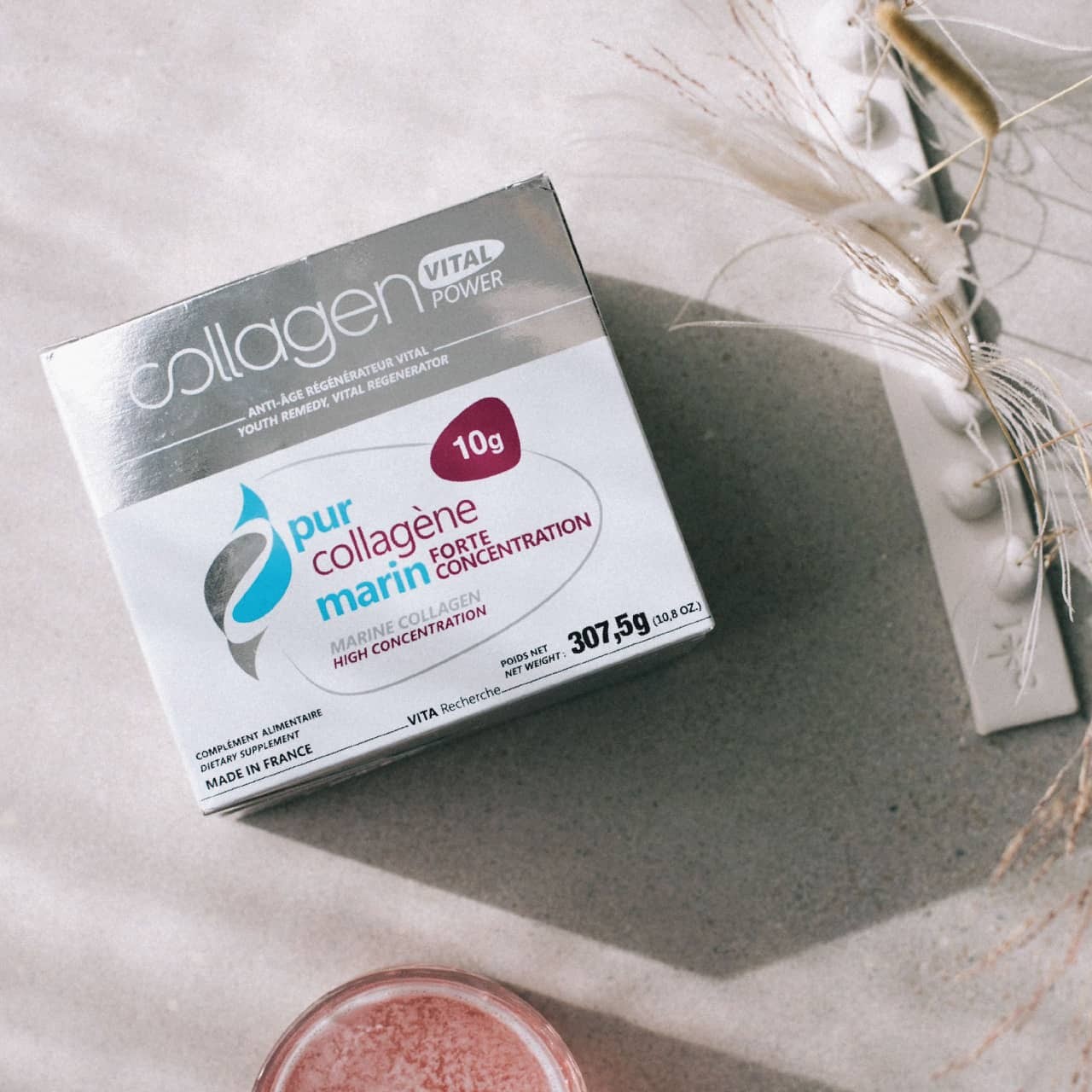
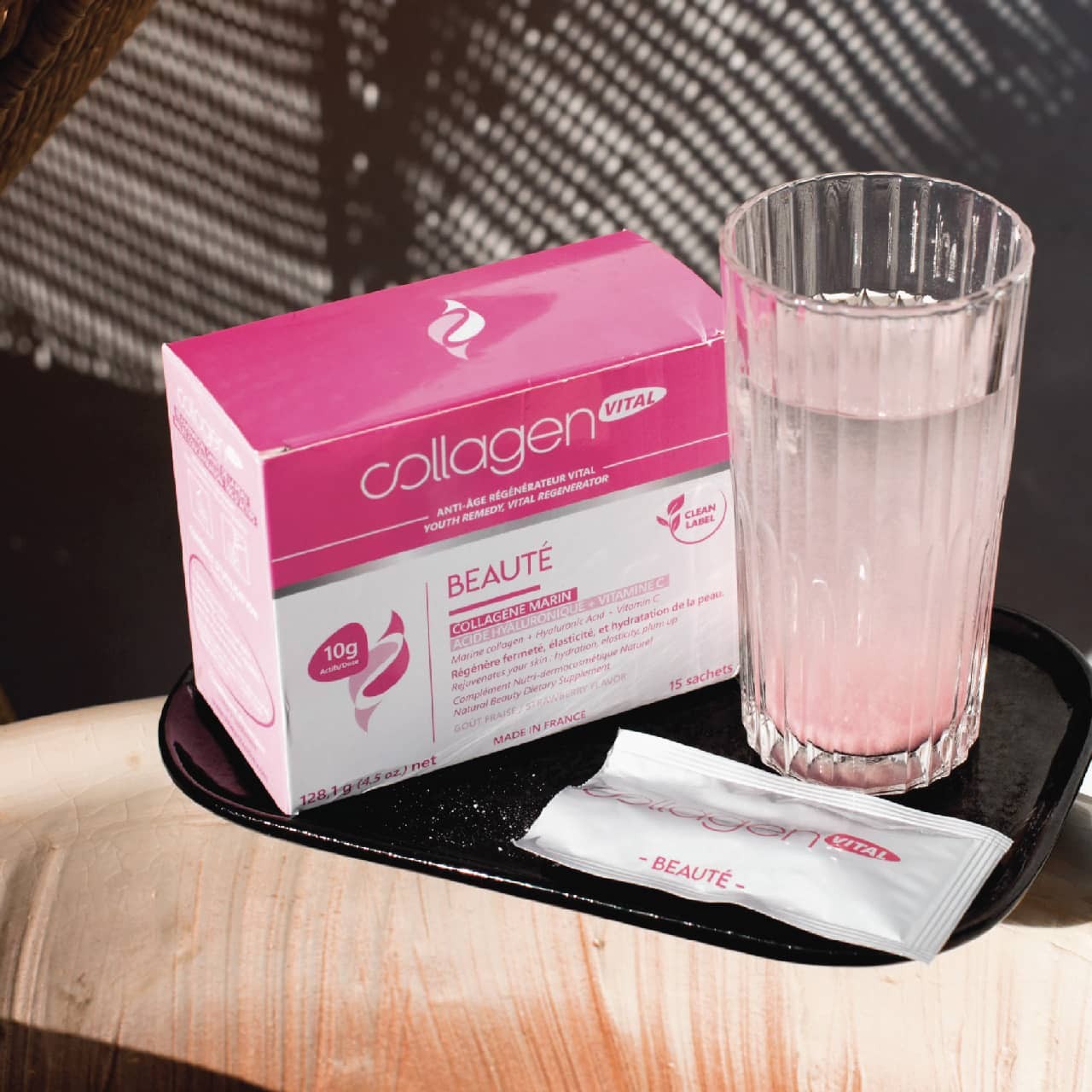
Numerous studies prove the anti-ageing effectiveness of marine collagen. “There is a growing body of scientific evidence showing the benefits of marine collagen supplementation on skin, hair, nails, joints, and the digestive system,” adds Dr Dalle. “The results have shown that 8 to 10 grams of marine collagen taken daily for 1 to 3 months are required. As an example, COLLAGEN VITAL POWER at 10 grams per dose has demonstrated its anti-ageing potential in several independent, placebo-controlled studies.”
What are the beauty benefits of marine collagen for skin?
From the first months, your nails will become less brittle and your hair stronger. Your skin will be better hydrated and more radiant. Fine lines and wrinkles will gradually fade. In short, your skin will find a new youthfulness.
“Marine collagen in pre-dosed sachets is an excellent complement to my aesthetic and plastic surgery procedures, both pre- and post-operatively. It delivers very good long-term results,” says Dr Claude, aesthetic physician in Paris. “It ensures dermal reconstruction by stimulating the cellular activity responsible for the regeneration of deep collagen.”
So, what about topical marine collagen?
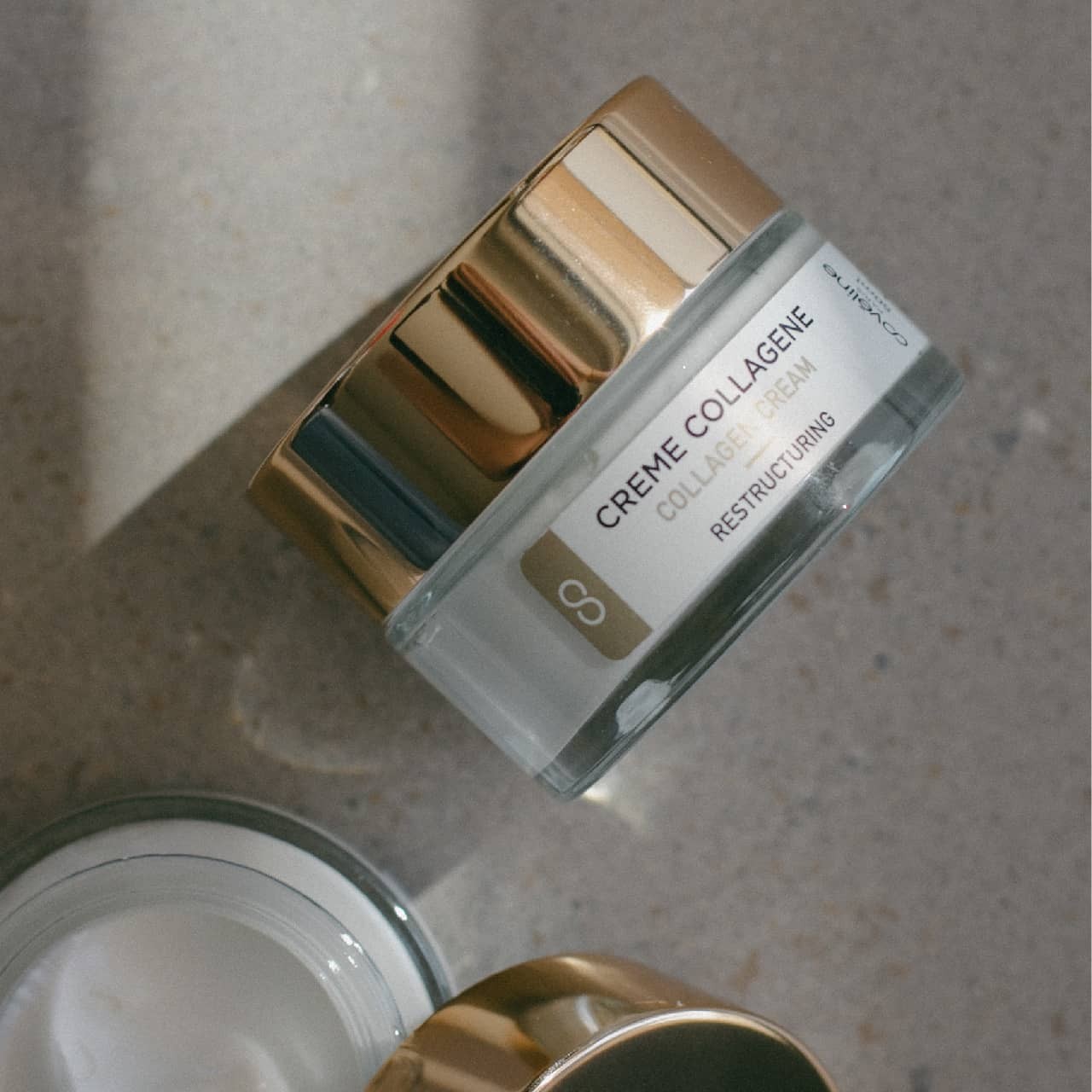
Well, first of all, it is important to know that collagen does not penetrate the skin well, because its molecular weight does not allow it to cross the epidermal barrier. Only a hydrolysed form in the shape of drinkable peptides allows absorption by the body and therefore an effective action on the regeneration of its own collagen. However, “A topical cream will protect your skin against the free radicals that damage collagen, while the active peptides in COLLAGEN VITAL POWER will restart the production of your own collagen at the very heart of the skin ageing process. Combine the two and you will get outstanding results,” says Marie de Ribains.