Collagen peptides: types, hydrolysis and di-/tripeptides
Collagen types, hydrolysis, di- and tripeptides: what science says about marine collagen and how to choose a collagen supplement that truly works for you.

Not all collagen supplements are created equal. Behind the single word “collagen” lie different types, different manufacturing processes and, above all, different peptide sizes. This article takes the scientific angle: which collagen types matter, why hydrolysis is essential and why di- and tripeptides attract so much research interest.
Collagen types: which one matters most?
There are 28 types of collagen in the human body. Type I is by far the most abundant: it accounts for roughly 90% of the body's collagen. It is the type that gives structure to skin, bones, tendons and ligaments.
Other types play more specialised roles:
- Type II is found mainly in cartilage.
- Type III often accompanies type I in the skin, blood vessels and organs.
- Type IV forms the basement membranes that support cells.
This is why type I collagen is the one most often highlighted for skin, bones, tendons and joint comfort. Some supplements combine it with type II or III.
Why collagen must be hydrolysed
The native collagen molecule is too large to be absorbed as is. Hydrolysis is the manufacturing step that cuts it into small fragments, the peptides. When properly controlled, it determines the quality of the final product.
During digestion, these peptides are further broken down into free amino acids, dipeptides (2 amino acids) and tripeptides (3 amino acids). The body then uses them according to its needs.
The role of vitamin C
Good to know: vitamin C is involved in the body's natural production of collagen. A diet rich in fresh fruit and vegetables (citrus, kiwi, bell pepper) helps support it.
Di- and tripeptides: why research is so interested
This is now one of the most studied subjects in collagen science. Research has shown that certain small peptides, notably Pro-Hyp (proline-hydroxyproline) and Hyp-Gly (hydroxyproline-glycine), remain in the bloodstream for several hours after intake.
Their appeal: they would not only serve as “building blocks”, they would also act as biological signals. Studies suggest they can stimulate fibroblasts, the cells that produce collagen, and support the production of type I collagen, elastin and hyaluronic acid. In short, these peptides “encourage” cells to maintain the matrix that gives skin its structure.
Not all hydrolysed collagens end up with the same peptide profile: the cutting process, the fragment size and their sequence all matter. This is what sets a premium collagen apart from a standard one.
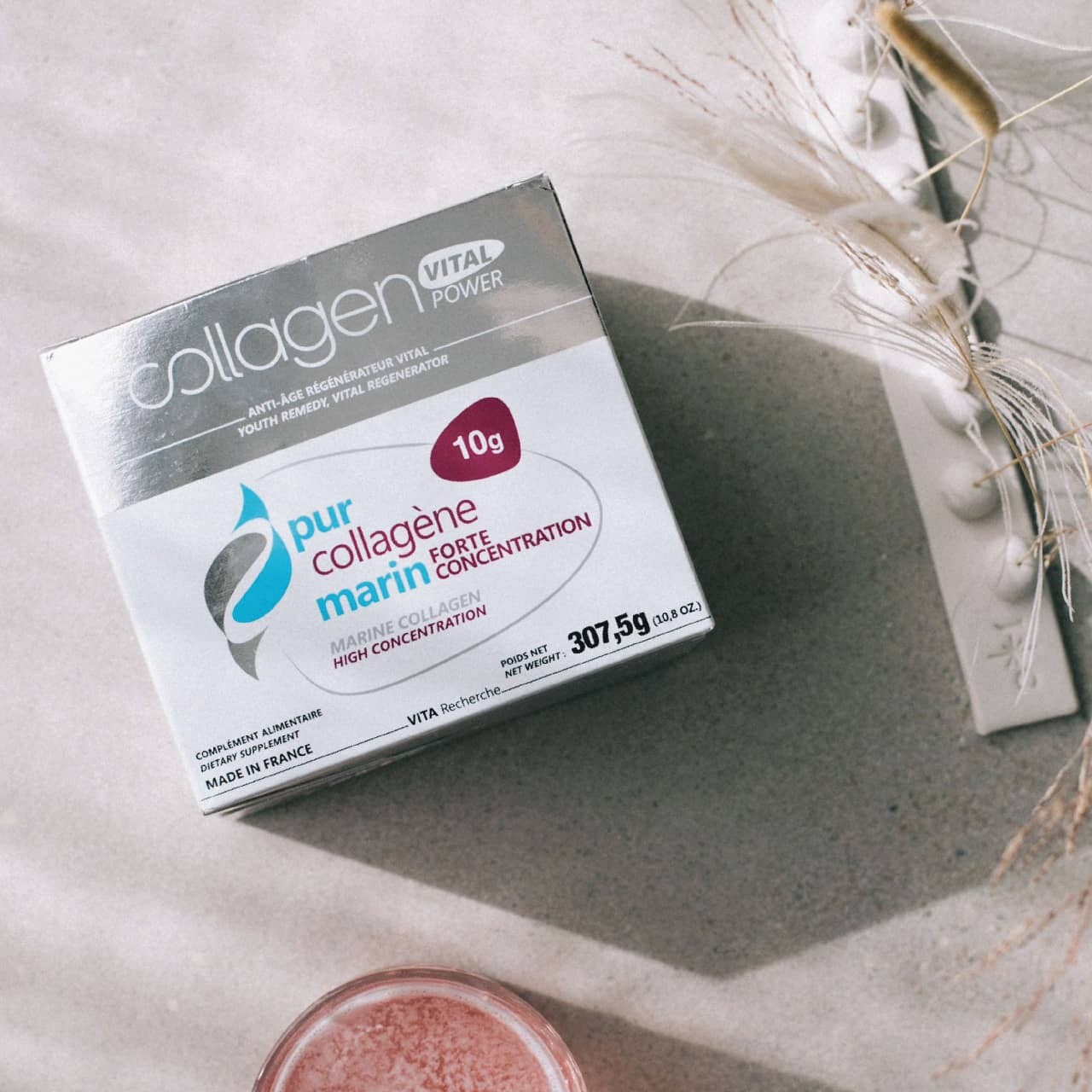
At Vita Recherche, the marine collagen comes from fish skin. It is hydrolysed through a rigorous process to obtain small peptides, rich in di- and tripeptides.
What do clinical studies say?
For the skin, the results are broadly positive. Meta-analyses observe that after 8 to 12 weeks of daily intake, at doses of around 10 g of collagen peptides, skin hydration, elasticity and dermal density can improve.
For the joints, several studies report better joint comfort, particularly in athletes and people over 40. For tendons and ligaments, the data are encouraging and research is ongoing.
To explore the detailed benefits of collagen, see our page on the benefits of Collagen Vital Power.
What matters: peptide size more than origin
Once hydrolysed, marine and bovine collagen show fairly similar bioavailability. What really makes the difference is the degree of hydrolysis, the peptide size and the presence of di- and tripeptides. Marine collagen is valued for its composition rich in type I, close to that of human skin.
The 3 criteria for an effective collagen
- A hydrolysed collagen, mostly type I.
- Small peptides, rich in di- and tripeptides.
- A daily intake, at a sufficient dose, over several weeks.
In summary
The idea that the di- and tripeptides of hydrolysed collagen act as biological signals is now supported by solid scientific data. The observed benefits require regular intake over several weeks and depend above all on the quality of the peptides.
Ready to start? Discover the Collagen Vital range and choose the cure that suits your needs.

Related products
Collagen Vital Power