Marine collagen cure: which protocol for your age?
How much marine collagen should you take at 25, 35, 45 or 55+? Our cure protocols by age: dosage, duration and the results you can expect week after week.

Everyone talks about collagen as a must-have ingredient, yet few people really know how to use it and fit it into their daily routine to get results. What dose? For how long? At what age should you start? Here is how to find the right rhythm for your marine collagen cure and see lasting benefits.
Why does collagen production decline with age?
Natural collagen production starts to decline gradually from the age of 25. The drop becomes steeper over the years and can show up as:
- loss of skin firmness and more pronounced wrinkles;
- thinner hair and more brittle nails;
- reduced joint comfort;
- slower recovery after exercise.
A marine collagen cure helps you support this inevitable process, provided it matches your needs and comes with a healthy lifestyle. If you are still unsure which collagen to pick, our article How to Choose the Right Marine Collagen reviews the key criteria.
Cure protocols by age
Between 25 and 35: preventing collagen loss
At this age the body still produces a significant amount of endogenous collagen, but production is beginning to slow down. The aim is to support natural collagen synthesis and preserve your youth capital.
Recommended protocol
- 1 sachet of hydrolysed marine collagen peptides a day, dosed between 8 and 10 g;
- a 2 to 3 month cure;
- repeated once or twice a year.
To optimise collagen synthesis, make sure your diet provides enough vitamin C, protein and antioxidants.
Between 35 and 45: preserving skin firmness
The decline in collagen becomes more visible: first wrinkles appear and the skin gradually loses elasticity. The aim is to maintain skin quality and support connective tissue.
Recommended protocol
- 1 sachet of 10 g of hydrolysed marine collagen peptides a day;
- a cure of at least 3 months;
- ideally 2 cures a year, in the in-between seasons such as autumn and spring, for deeper results.
At this age more than any other, it is the regular daily intake that makes the product effective.
Between 45 and 55: supporting hormonal changes
In women, perimenopause and menopause come with a faster decline in endogenous collagen. Men also experience a gradual decrease linked to ageing. The aim here is to preserve skin density, support joint comfort and help maintain connective tissue, including bone.
Recommended protocol
- 1 dose sachet of 10 g a day;
- a cure of 3 to 6 months for sufficient effectiveness;
- longer supplementation may be considered if well tolerated.
If you are going through this stage, our article on menopause in summer: hot flashes and collagen offers further advice.
After 55: supporting skin, joints and connective tissue
With age, collagen production becomes markedly lower. The aim then becomes global: maintaining mobility, supporting the skin and its firmness, helping to soften wrinkles and fine lines, supporting thinner, more fragile hair, and preserving the comfort of joints and tendons so you can keep moving and stay active.
Recommended protocol
- 10 g of hydrolysed marine collagen peptides a day;
- as a 6-month cure, or as a regular intake throughout the year, following the advice of a healthcare professional.
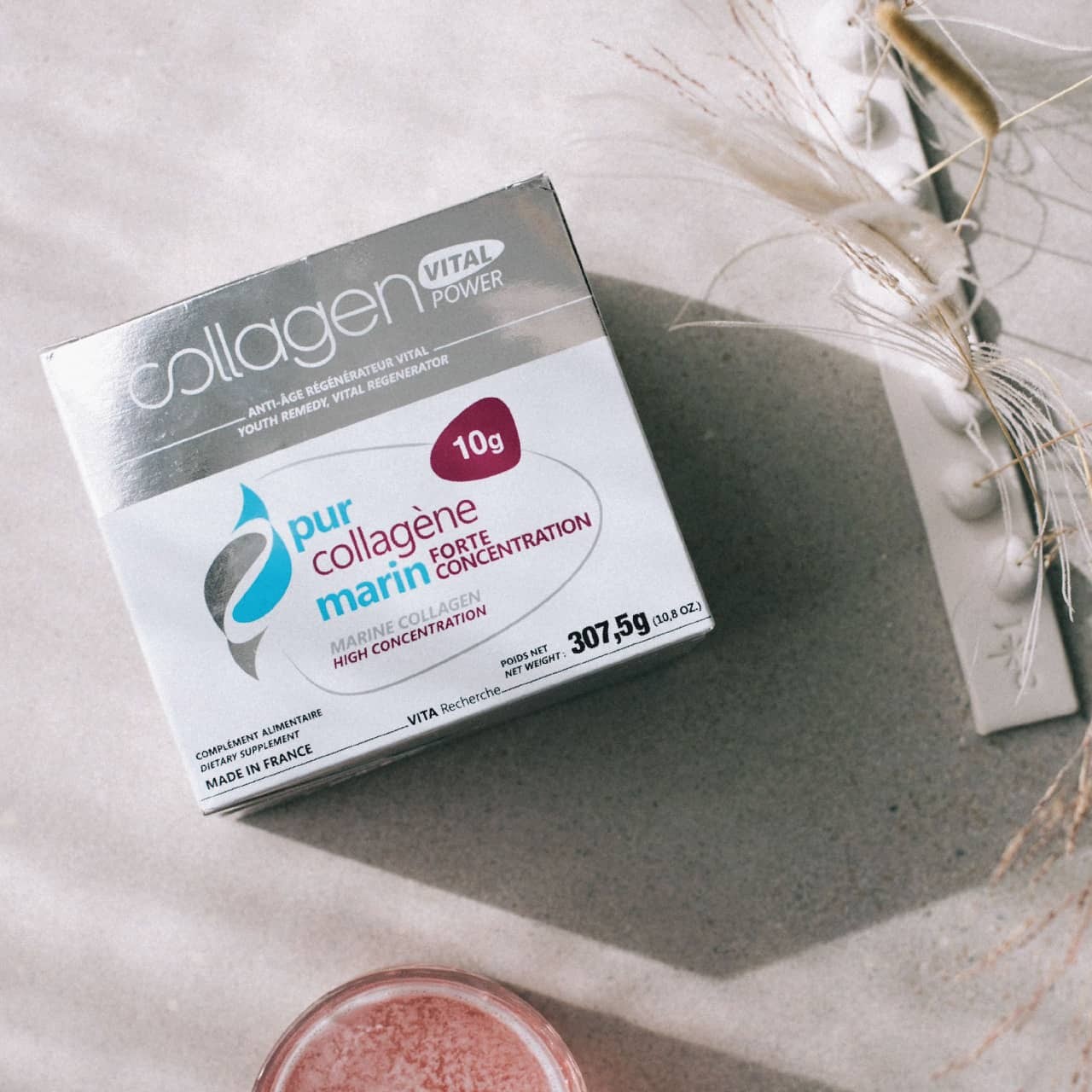
Discover Collagen Vital Power →
10 g of pure marine collagen peptides per sachet, the foundation of every protocol.
Special cases
Athletes
After intensive training sessions that put tendons, ligaments and cartilage under strain, a supplementation of 10 to 20 g a day is recommended, i.e. 1 to 2 sachets of Collagen Vital Power. This marine collagen peptide dosage was notably used in a study carried out with rugby players in their thirties, with performance and recovery in mind. To go further, read our sports protocol: protein supplements or marine collagen?
After significant weight loss
A cure of 10 g a day in dose sachets for 3 to 6 months can be part of a broader approach including a balanced diet, regular physical activity and sufficient protein intake. Our article Weight Management, Marine Collagen and Longevity explains this approach in detail.
For weakened hair
Hair that thins or falls more at certain times of the year calls for targeted support: read our article on hair loss and marine collagen.
The keys to an effective cure
To get the most out of marine collagen supplementation:
- choose hydrolysed marine collagen peptides, whose bioavailability is optimal;
- make sure you get enough vitamin C, which contributes to normal collagen formation;
- keep a diet rich in quality protein;
- stay well hydrated throughout the day;
- limit smoking and excessive sun exposure, which speed up collagen breakdown.
How long before you see results?
Timelines vary from one person to another and depend on your goals. As a guide:
After 4 to 8 weeks
Improved skin hydration and suppleness, along with a better feeling during exercise.
After 8 to 12 weeks
A gradual improvement in skin elasticity, better joint comfort, easier recovery after exercise and less muscle soreness.
After several months
Benefits may be seen in day-to-day joint comfort, in mobility and in a general sense of well-being, felt both on the skin and in the body.
These results depend on many factors (genetics, lifestyle, physical activity) and are not the same for everyone.
The best protocol is consistency
A daily intake, combined with a balanced diet, enough vitamin C and a healthy lifestyle, matters far more than the exact time of day you take your collagen.
Want to pick the formula that matches your goal? Discover our full range of marine collagen drink cures: Power for the most concentrated formula, Beauty for the skin, Hair & Nails or Slimming & Detox.
Read more